
Traverse City, MI · Garage Door Service
Why Garage Doors Fail Faster in Traverse City's Older Neighborhoods
Traverse City's garage doors mostly date to 1967-2001, built before today's tighter insulation codes. Cold winters find gaps in old seals, springs, and openers fast. Know when to call.
- Repairs & new doors
- Springs & openers
- Serving 7 nearby communities
When to Get Help
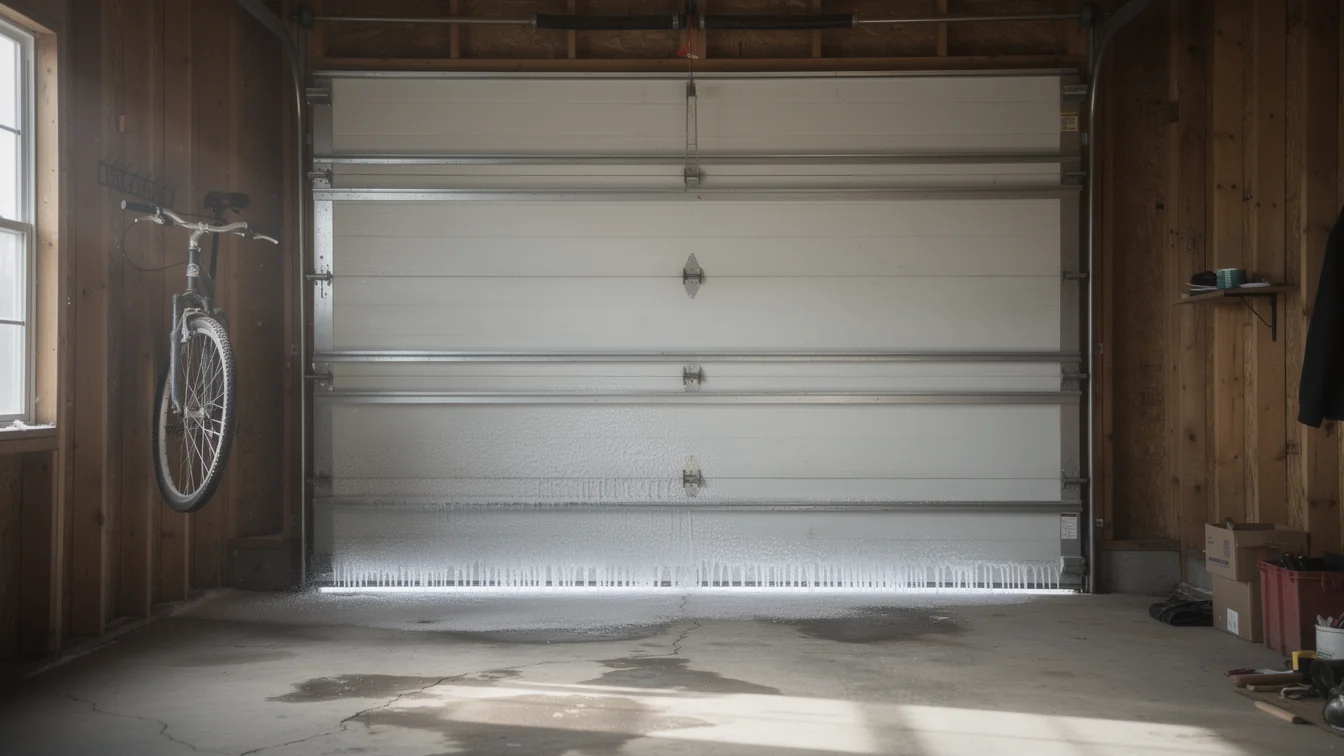
Most of the garage doors we look at around Traverse City went up somewhere between 1967 and 2001, with the bulk sitting right around 1988. That matters because a door built in that window was never designed to the tighter insulation and sealing standards that came later. If your door drags ice along the bottom track every winter, if the bottom seal is cracked and daylight shows through the corners, or if the opener strains and reverses on cold mornings, that's not random bad luck - that's the age of the unit meeting a hard winter. Call before a spring snaps rather than after. A torsion spring that's been cycling for three decades in a cold garage is already weaker than it looks, and when it lets go on a double door it can do it without warning. If the door is noticeably harder to lift by hand once the temperature drops below freezing, that's worth a look now rather than in February when everyone else is also calling. We'd rather look at a door that turns out to be fine than get the call after a cable has already come off the drum.
The Problem
Across the fifteen or so named areas we work in, the housing stock skews heavily to the late 1980s and 1990s, with the earliest of it going back to 1967. Out of roughly 8,874 households in the service area, about 6,627 are owner-occupied houses - and a large share of those still have the original garage door or a direct replacement that matched the same opening and the same era of hardware. Doors from that period typically used thinner steel skins, minimal or no polystyrene core, and seals that were adequate for the building codes of the time but thin by current standards. The track and roller systems are usually fine mechanically - steel doesn't care what decade it is - but the insulation value and the weatherstripping were never built for the kind of sustained cold this area gets. That combination is what shows up as the common complaint: a door that's structurally sound but lets cold air pour in around every edge, and an opener that was sized for a lighter, better-sealed door than the one it's actually been fighting for twenty years.
How Local Conditions Play In
This area sits in a severe cold climate band, and that changes what breaks and when. Steel contracts in the cold, which means tolerances that were fine in August get tight in January - rollers bind, tracks pull slightly out of alignment, and lubricant that worked fine three months ago turns gummy. Torsion springs lose a measurable amount of lifting power as temperature drops, so a spring that was already near the end of its life cycle is far more likely to fail on a sub-zero morning than on a mild one. Openers with older gear sets work harder to compensate, and that extra load is what burns out a drive gear or a capacitor years before it should have failed. None of this is unique to any one house - it's the same physics acting on housing stock that was built for a 1988 energy code, not a 2024 one. If you're in one of the areas we cover - Greilickville, Grawn, Interlochen, Kingsley, Suttons Bay, and the rest - the door on your garage is almost certainly dealing with the same mismatch between its original design and the winters it's actually facing now.
Leaving It Alone
Here's the honest part: not every one of these doors needs to be replaced, and we're not going to tell you it does. A worn seal and a dragging bottom bracket can often be fixed for the cost of a service call, and a door with good panels and a sound frame is worth repairing even if it's pushing thirty years old. Where it stops making sense is when the panels themselves are bowed or rusted through from decades of condensation in an unheated garage - at that point you're paying labor to prop up steel that's already failing, and a new door with a proper thermal break will cost less over five years than repeated patch repairs. We also won't pretend we can source obsolete hardware instantly; some parts for doors from this era are special-order and take longer to get than a same-week repair on a newer unit. If that's the case, we'll tell you upfront instead of stringing out a repair that won't hold.
Frequently asked questions
Why does my garage door get so much harder to open in the winter?
Steel contracts in the cold and torsion springs lose some of their lifting force as the temperature drops. On a door built in the 1980s or 90s, the spring has usually been cycling for decades already, so the combination of age and cold is what you're feeling. It's also the most common time of year for a spring to actually break.
Do I need a whole new door or just better seals?
If the panels and frame are solid and the problem is just cold air coming through the edges, new weatherstripping and a bottom seal usually solve it without replacing the door. Replacement makes more sense once the panels themselves are rusted, bowed, or the door is fighting the opener constantly.
Is my garage door old enough to be a problem?
Most houses in this area were built between 1967 and 2001, with 1988 as a rough midpoint, so a large share of garage doors are original or close to it. Age alone isn't a failure point, but doors from that era weren't built to current insulation or sealing standards, which is where most of the cold-weather complaints come from.
Related garage door services in Traverse City
More garage door guides
Book garage door service in Traverse City
Call now or request a quote - tell us what the door is doing and where you are.